
Medium
Draw an energy profile diagram for a three-step reaction in which the first step is the slowest and the last step is the fastest. (Assume that the reaction is exothermic)
- A
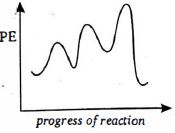
- B
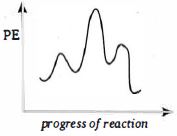
- C
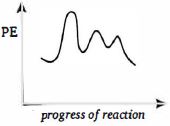
- DNone of these
Explore More
Similar Questions
The rate constant of a reaction increases by five times on increase in temperature from $27^{\circ} C$ to $52^{\circ} C$. The value of activation energy in $kJ \, mol^{-1}$ is $....$ . (Rounded-off to the nearest integer) $[R = 8.314 \, J \, K^{-1} \, mol^{-1}]$
For a reaction,$A \rightarrow B$,the average energies of $A$ and $B$ are $30 \ kcal/mol$ and $60 \ kcal/mol$ respectively. The energy of activation for the backward reaction is $93 \ kcal/mol$. The energy of activation for the forward reaction is:
The rate of a certain biochemical reaction at physiological temperature $T$ occurs $10^{6}$ times faster with an enzyme than without. The change in the activation energy upon adding the enzyme is
Decomposition of a hydrocarbon follows the equation $k = (5.5 \times 10^{11} \text{ s}^{-1}) e^{\frac{-28000 \text{ K}}{T}}$. The activation energy of the reaction is . . . . . . $\text{kJ mol}^{-1}$. (Nearest Integer) Given: $R = 8.3 \text{ J K}^{-1} \text{ mol}^{-1}$
DifficultJEE MAIN 2026
View SolutionAccording to the Arrhenius equation, which of the following statements is correct?
MediumGUJCET 2025
View SolutionVedclass Products
For Students
Vedclass Test Series
Mock tests in real JEE/NEET style with performance analysis. 5-day free trial.
Start Free TrialFor Teachers
Exam Paper Generator
Generate Set A/B/C/D exam papers from 7.5L+ questions in 2 minutes. 3 chapters free.
Try FreeFor Institutes
Online Exam Module
Live online exams with unlimited students, 360° analytics & white-label branding.
See Demo